It's no secret that I'm a fan of the stealth game genre. From classics like Thief and Metal Gear Solid (and more recently, Splinter Cell) to more modern titles like Dishonored, Hitman, or even hidden gems like Shadwen, Mark of the Ninja, and Aragami. There's something about this genre that really triggers an endorphin rush in me. Whether it's the ability to be a shadow, silently eliminating enemies one by one, or a ghost that slips by unnoticed, or perhaps it's the near-voyeuristic feeling of total control and the opportunity to observe and uncover various secrets.
Even in TES IV: Oblivion and TES V: Skyrim, a significant portion of my playthroughs was spent as a stealthy archer.
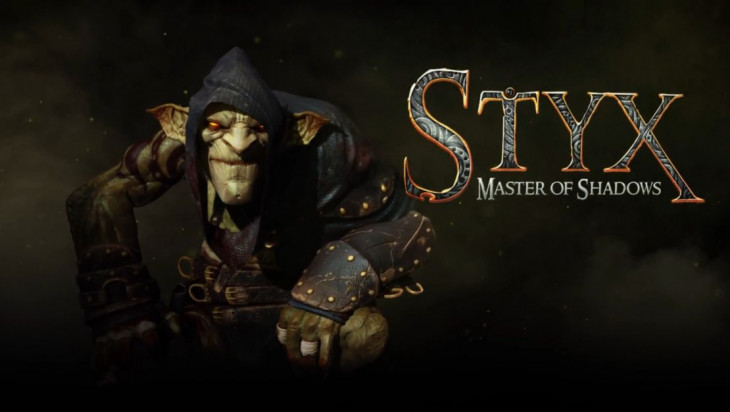
Styx: Master of Shadows, however, was a pleasant discovery. While essentially clearly a B-tier game, it's the one that doesn't make compromises. There's no "easy way" through combat like in Dishonored. After a string of projects where stealth was merely an option, a game that ruthlessly punishes any detection and forces you to think like a shadow was long overdue. This is a return to the genre's roots, where your critical thinking and quick wit will be your main weapons.
Story:
The story serves as a prequel to Of Orcs and Men (which I haven't had the chance to play yet), detailing the past of one of its main heroes. You play as Styx: a two-hundred-year-old goblin suffering from amnesia and obsessed with finding the origins of his existence. His path leads through the Tower of Akenash: a giant citadel built around the World Tree, whose sap, amber, is a source of great power.
The plot doesn't exactly involve unique tropes; quite the opposite (the hero's journey, amnesia). But its main strength lies in its delivery through a cynical and witty protagonist. Dialogues, laced with strong language and excellent voice acting, make Styx a truly charismatic protagonist. While the overall story may not seem the most original, and some twists are not as powerful as they can be, the story is decent nevertheless: you are a small, despised creature in a world of giants, and your strength lies not in power, but in cunning.
And let's be honest, when was the last time you played as a goblin?
Graphics:
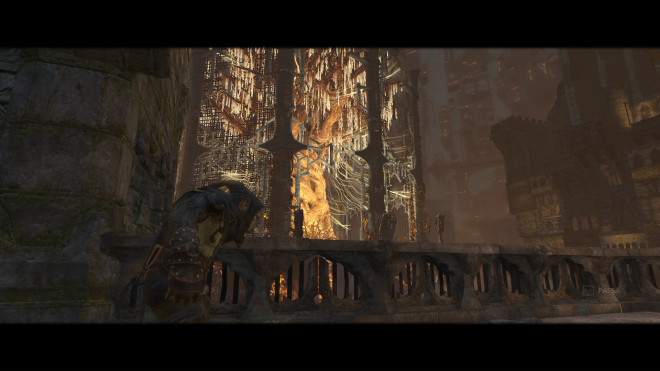
Visually, the game doesn't try to compete with AAA blockbusters even from its own time (2014). Textures can seem simple, and animations can be a bit scuffed. However, Styx has its own atmospheric identity. A dark fantasy style, at times caricatured and reminiscent of Fable or Overlord, creates a memorable world, albeit not as cartoonish as the aforementioned titles.
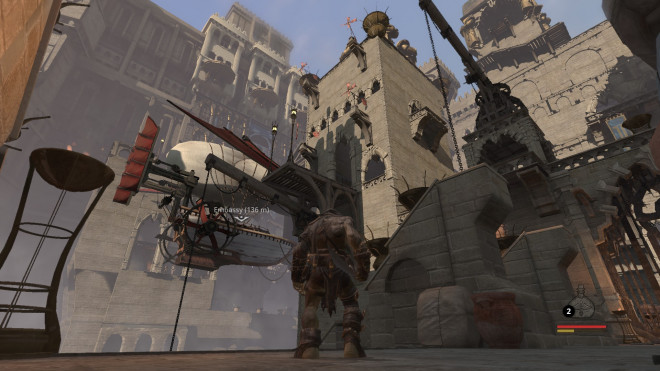
The key feature is the incredibly thoughtful level design. The Tower of Akenash isn't a set of corridors. Once you pass the prologue, you discover that it's a giant, multi-level, truly vertical puzzle. It's even more impressive when open areas reveal the full scale of this structure. Each location (libraries, prisons, factory floors) is crisscrossed with ventilation shafts (very convenient for a goblin to crawl through), beams, ledges, and hidden passages. You're constantly looking not just side to side, but up and down, searching for a path. While the graphics are technically modest, this design is perfect for a stealth game.
Audio:
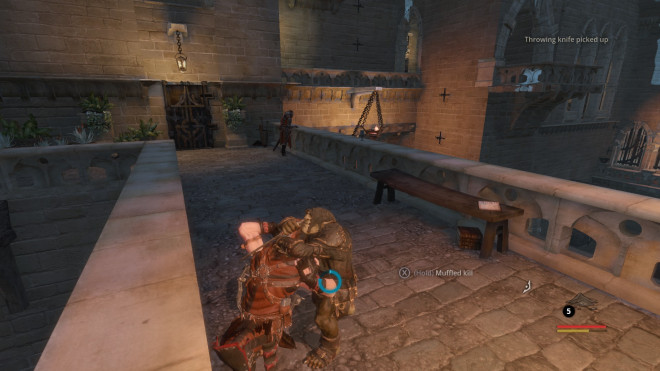
You can determine the type and direction of a guard's movement by the click of their heels on stone floors or wooden planks. The sound of a bucket or chair knocked over by a careless touch will instantly attract the attention of all enemies nearby. All of this forces you to move deliberately and listen to every rustle.
And this attention to detail was a surprise to me. On my first mission playthrough, I was only detected because I jumped or ran relatively close to enemies. On a repeat run (trying to meet the no-kill and no-alert conditions), I carelessly brushed against a chair, which made a noise and attracted an enemy's attention.
The soundtrack, consisting of tense strings and dark ambient compositions, masterfully builds pressure. It's barely audible when you're safe but swells into a pulsating rhythm when you're on the verge of failure. I particularly liked the calm melody that plays in your hideout.
As mentioned, Styx's voice, performed by Saul Jephcott, is a separate attraction. His sarcastic comments, growling whispers, and philosophical ramblings in his own head bring the character to life, and what a character he is.
Gameplay:
This is stealth in its most raw form. The game's philosophy is simple: if an enemy detects you, you're in trouble. If it's one enemy, you're in for a fight where your only chance for survival is dodging, and only if you get the timing right.
And if there are several enemies, you're most likely already dead. Styx is weak, and a direct confrontation with more than one opponent will almost certainly send the player to the loading screen. And don't even think that jumping on a cabinet will save you, as enemies can throw knives at Styx, not to mention crossbowmen.
But don't worry, some basic tools and actions will help you on your journey:
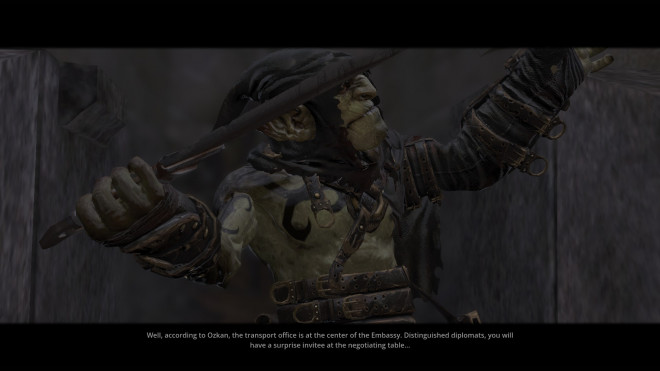
1) Genre Classics: Crouch, hide in shadows and cabinets, perform silent takedowns from behind. The player can hold the attack button during a stealth kill, which significantly increases the time taken to kill but also greatly reduces the noise produced by the enemy. Note: it doesn't eliminate it, only reduces it. So you can't mow down a group of enemies one by one if they're close enough together. It's also important to remember that shadows here don't make you invisible, only reduce the chance of being spotted. But at least the Styx's markings will glow in the dark, telling you when you're covered in shadows.
2) Environmental Interaction: You can (and should) extinguish torches to create safe zones. You can poison food, drop chandeliers, and set traps.
3) Equipment: Styx carries a limited inventory. This includes health potions and amber potions, as well as a sand pouch for extinguishing distant torches. And let's not forget the throwing knives, which Styx carries in his pockets, two at a time. They are convenient for killing enemies from a distance.
Since we're in a fantasy universe, the game has magic abilities: amber magic.
1) Amber Vision: Highlights enemies, interactions, and important objects.
2) Short-term Invisibility: Extremely resource-intensive, used to pass critically dangerous points.
3) Clone Creation: Styx can...create a clone from vomit. This is a very gross key tactical mechanic. The clone can distract guards, switch levers, squeeze through narrow gaps, and even create a smoke screen by blowing up. Controlling two bodies (not simultaneously) opens up additional possibilities for solving problems.
Between missions, we return to our secret base, where we can replenish consumables, talk to characters, replay previous missions, and upgrade skills.
Thoughts:
Styx: Master of Shadows is rough-around-the-edges game that is wholly devoted to the ideals of pure stealth. It doesn't aim to please everyone. Its rough edges (imperfect platforming, sometimes simplistic AI, reused locations) are obvious and may be off-putting.
The combat system is a clunky quick-time event. Upon detection, you're locked into a duel with one enemy while others can freely attack you from behind. This isn't a bug, it's a feature - a direct demonstration that you're not meant to fight. However, this does lead to increased number of re-loading your last save, so you can try again.
Platforming was the most frequent source of my frustration. Aiming during jumps and grabbing ledges often feels imprecise. You think you'll definitely latch onto a ledge, but instead you watch Styx scream as he plummets into the abyss.
And yet, despite its flaws, I like this game. It offers no easy paths and makes you feel not like an all-powerful assassin (hello Talion from Shadow of Mordor), but like a fragile yet incredibly smart creature surviving by its wits. It's a challenge for patient players (at least on you first playthrough), which led me, as a genre fan, to this game. If you're willing to accept its harsh rules and forgive its technical imperfections, you'll find one of the most fun and memorable stealth experiences in the genre. It's not a polished big budget AAA, but rather a cult, hidden gem

AUTHOR INFORMATION

 It's fine, even if predictable at times.
Not the best out there, but serviceable.
 Sountrack is nice and Styx's voice actor did an AMAZING job, bringing this character to life.
 Limited but rewarding.
PROS / CONS
- Charismatic protagonist
- Atmospheric sountrack
- Creative level design
- Clunky platforming
- Muddy textures
- Lacks enemy variety