Although I am already familiar with voxel games, my opinions on Voxelgram will be revealed. Generally, it is a very novel and attractive experience, mainly if you are a puzzle-game lover and a voxel art fan. The review will be split into sections, where each aspect will have a score of 10 points.
Concept and Originality (9/10):
Initially, what made me pay attention to Voxelgram was its unique and new interpretation of the traditional nonogram or picross puzzle. Transitioning from 2D to 3D is indeed a smart move, and it turns what could easily be seen as simple pixel puzzles into almost sculptural challenges. One can say the act of building or deconstructing objects from hints is very gratifying and provides depth to the game which keeps it interesting. I also liked how the puzzles are dialectically linked with a certain thematic scene— like kitchen utensils or bathroom wares, thus providing a sense of purpose beyond mere puzzle solving. It’s both new and pays respect to the puzzle genre.
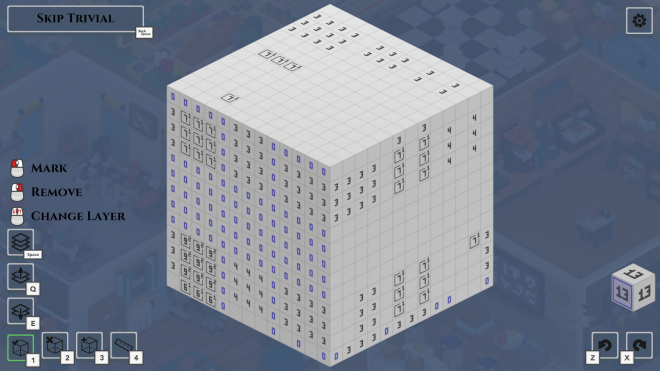
Gameplay Mechanics (7/10):
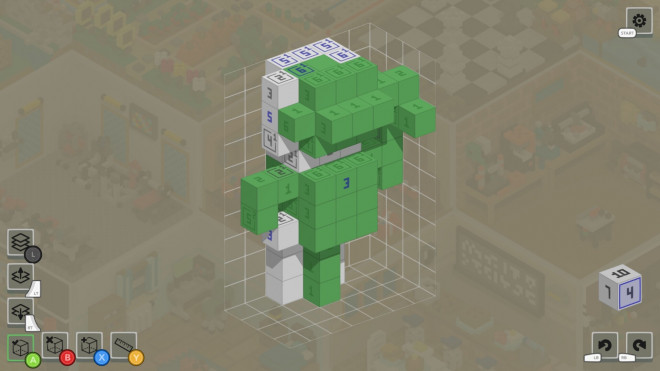
The main mechanics are entertaining but there is a bit of a learning curve involved. The game consists of marking & de-marking voxels depending on the numeric clues, and a couple of tools like a measuring device or perspective switching are provided to assist. Initially, the way clues are depicted could be unclear, particularly in the case of the gaps and picturing several layers, and the tutorial does not clarify some points very well. I had to spend some time learning how the clues work. But once I understood, the gameplay felt smooth. It rewards patience. The feature of no penalties for errors and the unlimited undoing options are just the right things, as they allow you to learn through stressless trial and error.
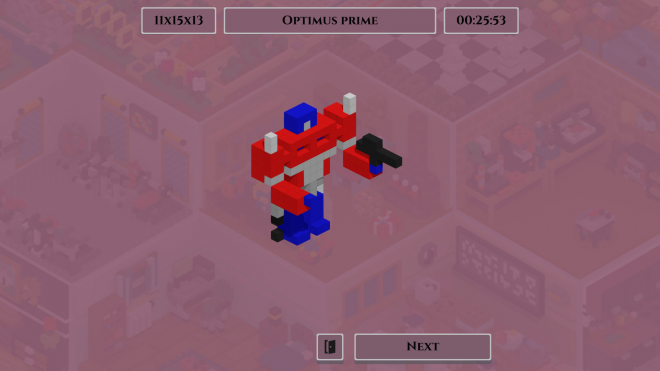
Graphics and Audio (8/10):
Voxelgram’s visuals are pleasing. The voxel art style suits the puzzle type well. The dioramas and object themes seem vibrant and colorful, adding to the immersion. The music, mainly the piano tracks, is calming and supports a focused mood. I even listened to the soundtrack while playing, which improved the whole experience.
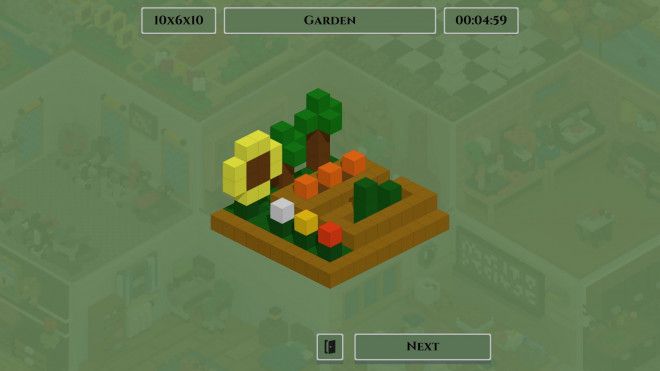
Interface and Usability (6/10):
This is an aspect where the game could get better. The interface works, but sometimes it is not very user-friendly. One case is going back to the level selection in order to get to the next puzzle or having to click through several menus just to change the resolution or see the level details, this all interrupts the flow. Also, some features like the un-dimension change or the error marking are easy to use, however, the absence of a “next level” button after the completion may not be appealing to some. Such weirdnesses are not serious but they count, especially when you are playing for a long time.
Content and Replayability (9/10):
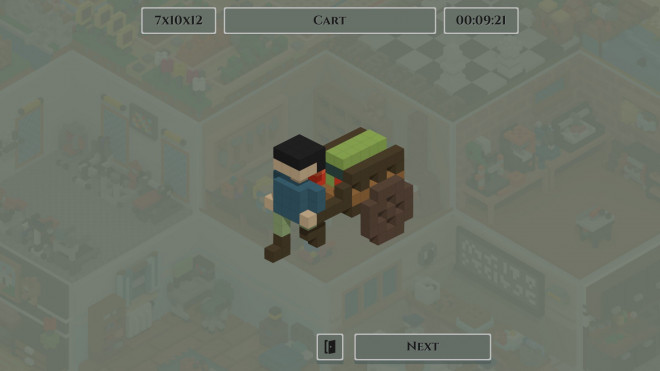
The game is packed with such an extensive amount of content with 256 levels distributed among many dioramas. Besides that, there are also workshop content and procedurally generated levels that enhance the replaying process significantly. I had a feeling of going through the handcrafted puzzles but I also found the random levels helpful for variety reasons although they might not be as gratifying as designers’ ones. The whole thing being available right from the start is what I liked since there’s no waiting or grinding involved. Do not be surprised if you take over 20 hours just for the main puzzle content, with way more to explore if you go into workshop or custom levels.
Difficulty and Challenge (7/10):
The majority of the puzzles are easily solvable but there are some that become quite hard at the end, particularly when you are trying to figure out the missing parts and the hidden voxels. It’s a nice distribution of difficulty—hard enough to keep one’s interest going without the frustration of it being impossible. The error highlighting and tools help when things get tough.
Overall Score: 8/10
This is a neat puzzle game that gives nonograms a 3D voxel twist. Although it does have its learning curve where you have to adjust to playing it in this particular way, it is actually quite original and entertaining once you are familiarized with it. I have logged 30 hours playing this game.

AUTHOR INFORMATION


 Voxelgram offers a fresh, creative twist on traditional nonogram puzzles by transforming them into immersive 3D voxel sculptures tied to themed scenes.
 The game involves logical voxel placement and removal using hints, tools, and perspective shifts, which can be challenging to master at first.
 Its charming voxel art style combined with relaxing piano music creates an inviting and immersive puzzle-solving atmosphere.
 While functional, the interface can feel a bit clunky with some menu navigation quirks that slightly disrupt the flow.
With over 250 levels, workshop support, and procedural levels, the game offers extensive content and high replay value.
PROS / CONS
- Unique 3D voxel puzzle gameplay
- Visually appealing voxel art
- Suitable for all ages
- Steep learning curve for beginners
- Potential repetitiveness