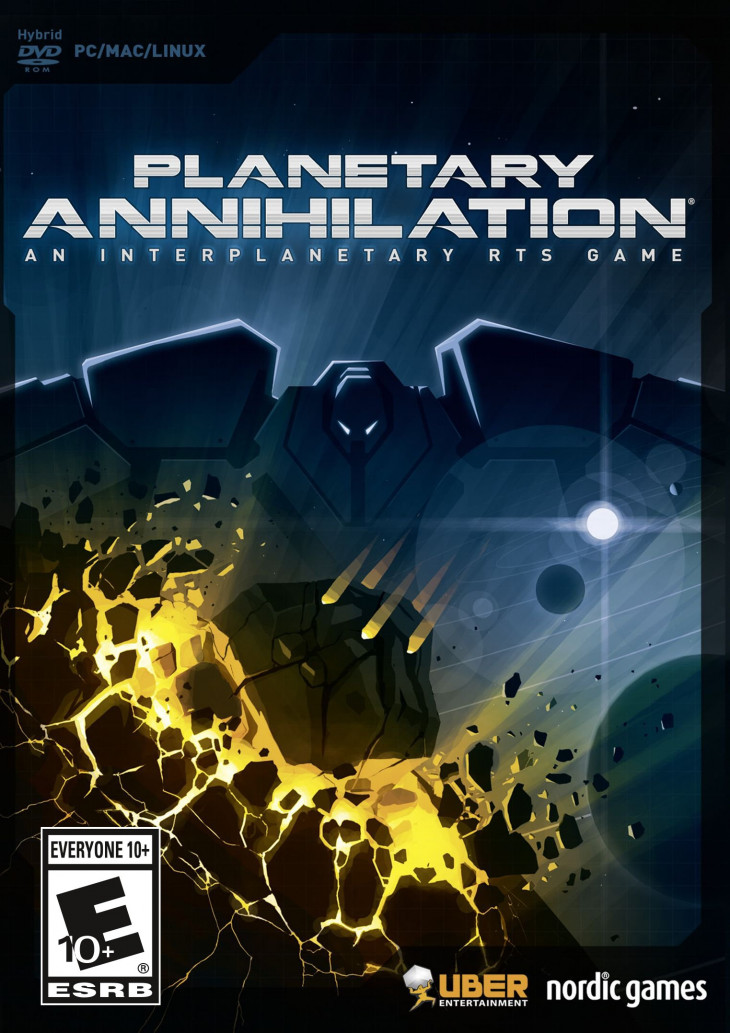
🎮 Game Information
- Developer: Uber Entertainment (now Star Theory Games)
- Publisher: Uber Entertainment
- Release Date: September 5, 2014
- Platforms: PC (Windows, macOS, Linux)
- Genre: Real-Time Strategy (RTS)
- Mode: Single-player, Online Multiplayer
- Engine: Proprietary (Uber Engine)
- Spiritual Successor To: Total Annihilation and Supreme Commander, designed by Jon Mavor, one of the lead designers behind Total Annihilation.
🌍 Introduction
Following many skirmishes, trying out many commanders and orchestrating battles that have grown from little bases to full invasions of entire planets, Planetary Annihilation certainly seems to be one of the most grandiose real-time strategy games ever developed.
No longer do you think just about conquering the battlefield but always about something way bigger. One minute, you are taking control of some metal deposit on your planet, and another minute, you are performing orbital invasions, colonization of moons and even throwing an asteroid to your enemy's planet. This is definitely the type of game that makes you realize the insignificance of each battle in case of total war in an entire solar system.
The grand scale is overwhelming but sometimes leads to certain sacrifices.
🕹️ Gameplay – 8.8/10
The game focuses on creating an economy, expanding territories, creating large robotic armies, and destroying your opponent’s Commander before he destroys yours. Players experienced with Total Annihilation and Supreme Commander will feel quite comfortable due to similarities in mechanics such as constant construction of units, resource management, and vast maps of battles.
Planetary Annihilation stands out from other RTS games by having multi-planet warfare. Not only do you have to fight for one map but also for multiple planets and moons and sometimes even multiple layers of orbitals. Building transporters, orbital factories, satellites, and interplanetary transportation systems makes every late-game battle chaotic and interesting.
There are many kinds of units in the game, including ground vehicles, aircraft, navy units, space ships, air defense, artillery, and experimental weapons. You need to learn when to control the skies, create superior navy or orbital units, just as much as building base.
One of the most unique features of the game is using celestial objects as weapons. Creating an asteroid collision against your enemy’s planet feels just as epic as it sounds.
Nonetheless, it is not an easy task. Managing different planets at once can be difficult, particularly for beginners. Though the user interface does its job well enough, it can lack clarity when dealing with huge battles.
🎨 Visuals & Art Style – 8.5/10
Planetary Annihilation, instead of focusing on ultra-realism, takes the route of a minimalist sci-fi aesthetic, which facilitates gameplay clarity during massive warfare.
Seeing robotic armies advance through spherical planets is quite awesome. The ability to pan from a singular tank to a whole solar system is one of the best technological feats of the game. It provides a commander total battlefield awareness.
The diversity in planet landscapes ranges from green forests to ice worlds, volcanoes, barren moons to planetary gaseous systems. Explosions, lasers from orbiting satellites, and asteroid crashes provide for spectacular effects that do not hinder the clarity of battles.
Unit models lack complexity when seen up close; however, given the number of units at once in the battle field, the compromise is quite justified.
🔊 Sound & Music – 8.3/10
The music is suitable for the scale of the game with science fiction orchestral scores that create tension as the story progresses and the action heats up. The music does not overshadow the experience, but simply enhances the impression of commanding an army that fights on the scale of civilization.
Effects of weapons used are very good, especially those that deal with the roar of artillery, orbital lasers and even planetary collisions. Sounds coming from the factories producing units help to feel an unstoppable war machine.
Notifications are informative and clear.
📖 Story & Atmosphere – 7.2/10
As opposed to most of the RTS campaigns, there is not much storytelling involved in Planetary Annihilation. There are no characters or any cinematic plot elements whatsoever. Instead, it is all about the sandbox battles.
Although the game does not feature a storyline, the atmosphere is highly successful. The match plays out its unique story via growing empires, defense, orbit invasion, and planet-destruction climaxes.
Just the scale is already enough to make you feel the suspense. It is much more memorable to see how the enemy moon is coming closer to your home planet than in many scripted stories of other strategy games.
Those who want a narrative campaign might be disappointed, but strategists will find the sandbox approach very liberating.
🐞 Bugs & Technical Performance – 7.5/10
While the performance is usually good in small-scale fights, when the game starts developing into large-scale multi-planetary wars involving several thousand units, it becomes an issue.
I also encountered:
- AI occasionally making questionable strategic decisions
- Pathfinding issues during extremely large battles
- Minor interface clutter when managing several planets simultaneously
- Long match durations increasing memory usage
Fortunately, I never experienced crashes or progression-breaking bugs. Most technical issues stem from the enormous simulation rather than poor optimization.
🔁 Replayability – 9.3/10
One of the aspects which make this game great is the replayability factor.
Solar systems, which are procedurally generated for each match, ensure that no match plays the same. The differences in planet size, resource placement, orbital setups, and multiplayer tactics mean there is literally infinite replay value in Planetary Annihilation. Experimenting with new build orders, different commanders, and better macro management will keep the player busy for many, many hours.
The online multiplayer mode is the most appealing aspect of this game since one always has something unpredictable from human opponents to deal with.
🔚 Final Verdict – 8.7/10
Planetary Annihilation has to be considered one of the most audacious real-time strategy titles ever produced. Instead of merely increasing the scale of conventional RTS gameplay, it reinvents the idea of warfare in the grandest manner possible, enabling its users to invade planets, dominate orbitally and wipe planets off existence in truly epic fashion.
Thanks to its ambitious gameplay, impressive replayability potential and great strategy depth, Planetary Annihilation turns out to be a superb title for hardcore RTS fans. Despite its technical drawbacks, difficult learning process and lack of a good campaign storyline, it still offers the best experience in terms of warfare on a planetary level.
If you always wanted to lead an army that could shape the whole solar system, here is your chance!

AUTHOR INFORMATION


 Great gameplay
 Visuals is good
I liked the SFX too
 Story was decent
Overall, it was great
PROS / CONS
- Massive planetary-scale RTS battles
- Incredible zoom system from units to entire solar systems
- Asteroid and planet destruction mechanics are unforgettable
- Excellent unit variety
- Spiritual successor worthy of Total Annihilation
- Very steep learning curve
- Weak narrative and no meaningful campaign
- Performance drops during massive battles
- AI can make poor strategic decisions
- Can feel overwhelming for RTS newcomers